A mirror for England : British movies from austerity to affluence / Raymond Durgnat ; with a foreword by Kevin Gough-Yates.
Material type: TextSeries: BFI silverPublication details: New York : Palgrave Macmillan, 2011Edition: 2nd edDescription: xxi, 394 pages : illustrations ; 20 cmContent type: text Media type: unmediated Carrier type: volumeISBN: 9781844574544 (hbk.); 9781844574537 (pbk.)Subject(s): Motion pictures -- Great Britain -- History | PERFORMING ARTS / Film & Video / History & Criticism | PERFORMING ARTS / Film & Video / General | PERFORMING ARTS / GeneralDDC classification: 791.430941 Other classification: PER004030 | PER004000 | PER000000 Online resources: Cover image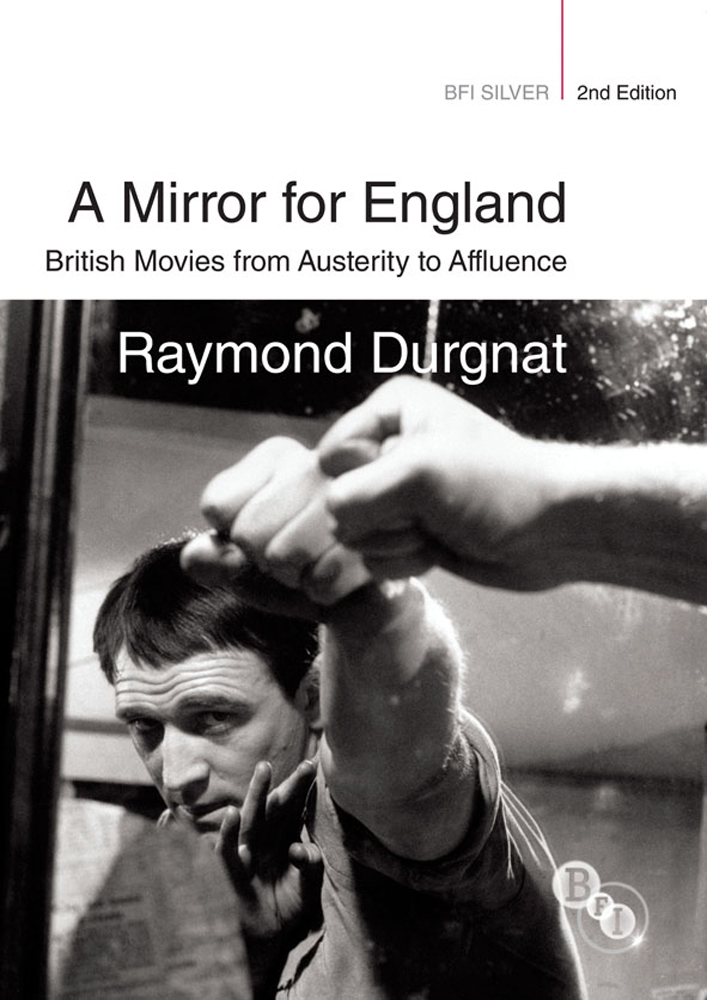
| Item type | Current library | Home library | Call number | Status | Notes | Date due | Barcode | Item holds |
|---|---|---|---|---|---|---|---|---|
| JKRC Social Science Complex | JKRC Social Science Complex | 791.430941 DUR (Browse shelf(Opens below)) | Available | PN103137 | BCL2526 |
Browsing JKRC Social Science Complex shelves Close shelf browser (Hides shelf browser)
| No cover image available | ||||||||
| 791.4309 JAK फ्लॅशबॅक : चंदेरी दुनियेत 'माणूस' (१९६१-१९८६) / | 791.430909352042 ROS Sexuality in the field of vision / | 791.43094 OST European Cinemas in the Television Age / Dorota Ostrowska and Graham Roberts. | 791.430941 DUR A mirror for England : British movies from austerity to affluence / | 791.430941 MUR The British cinema book / | 791.430941 SAR British cinema : a critical history / | 791.430954 BHO Cinema and censorship : the politics of control in India / |
Includes bibliographical references and index.
Machine generated contents note: -- Contents -- Introduction -- Where we come in -- When is a British Film a British Film? -- Meaning Cut Meaning -- Critic: Judge or Accomplice? -- CHAPTER I: THE STATE OF THE NATION -- The British Constitution -- Good Irresolutions -- Trouble at t'Mill -- CHAPTER II: CROSS SECTIONS -- The Nine Lives of Colonel Blimp -- Pigs in the Middle -- Journey to the edges of the Working-Class -- Odds and Bods -- CHAPTER III: POINTS OF VIEW -- Left, Right and Centre -- And so, as the Sun Sets slowly, We Bid Adieu -- Tunes of Bogey -- Gangrene--British Style -- Standing up for Jesus -- Bloody Foreigners -- CHAPTER IV: OUR GLORIOUS HERITAGE -- History is Bunk -- The Impotence of Being Earnest -- The Doctored Documentary -- CHAPTER V: THE AGE OF ACQUIESCENCE -- System as Stalemate -- Dance to your Daddy -- Stresses and Strains -- My Famous Last word is my Bond -- God Bless Captain Vere -- Hard Conscience and Nonconformity -- The Glum and the Guilty -- Laugh and Lie down -- Love in a Damp Climate -- The Lukewarm Life -- CHAPTER VI: ROMANTICS AND MORALISTS -- Between Two Worlds -- A Gothic Revival -- Terence Coloured -- Shammerteurism -- Flesh and Fantasy -- The English Moralists -- Have Scalpels--Will Travel -- Suspended Animation -- Lists -- References -- Bibliography -- Filmographical Index -- Film Artists Index -- Foreign Film Artists and Film Index -- Other Names Index.
"Raymond Durgnat's classic study of British films from the 1940s to the 1960s, first published in 1970, remains one of the most important books ever written on British cinema. In his introduction, Kevin Gough-Yates writes: 'Even now, it astounds by its courage and its audacity; if you think you have an 'original' approach to a filmor a director's work and check it against A Mirror for England, you generally discover that Raymond Durgnat had said it already.' Durgnat himself said about the book that 'the main point was arranging a kind of rendezvous between thinking about movies and thinking, not so much about sociology, as about the experiences that people are having all the time.' Durgnat used Mirror to assert the validity of British cinema against its dismissal by the critics of Cahiers du cinéma and Sight and Sound. His analysis takes in classics such as In Which We Serve (1942), A Matter of Life and Death (1946) and The Blue Lamp (1949), alongside 'B' films and popular genres such as Hammer horror. Durgnat makes a cogent and compelling case for the success of British films in reflecting British predicaments, moods and myths, at the same time as providing some disturbing new insights into a national character by whose enigmas and contradictions we continue to be perplexed and fascinated"-- Provided by publisher.
There are no comments on this title.